
From data to intelligence: building a better understanding of young people's lives
By Rylie Sweeney, Founder & CEO, The Insight to Impact Collective
We know more about young people than ever before.
Across government and public services, data can tell us about attendance and attainment, destinations after education, employment and wellbeing. It can show how experiences differ between places, identify trends over time and help us understand where outcomes are changing. This evidence matters. Good decisions need good data. But having more data does not automatically mean we have a better understanding of young people's lives.
A dataset can tell us that a young person's attendance has fallen, but it cannot necessarily tell us why. It might show that someone is not in education, employment or training without explaining the experiences that led them there. Employment data can tell us whether a young person entered work, but much less about the journey that got them there, the opportunities they could realistically access or what helped them stay and progress.
Each measure tells us something. Very few tell us the whole story.
The question, then, isn't whether we need data. We do. It's how we turn the evidence we already have, alongside the evidence we still need to build, into intelligence that can improve decisions.
Young people's lives don't exist as separate datasets
One of the challenges is that much of our evidence reflects the way our systems are organised. We might understand a young person's education in one place and their employment in another, while other parts of their life sit elsewhere again. Those distinctions make sense for the institutions collecting the information, but they aren't how young people experience their lives.
Where someone lives can shape the opportunities they can access. Their experience of education can influence what happens when they enter employment. Transport can make an opportunity that exists on paper almost impossible to reach in practice. What happens within a family or community can shape how a young person experiences the institutions and services around them.
These things interact. If we look at one measure in isolation, we can understand an important part of the picture while still missing what connects it to everything else.
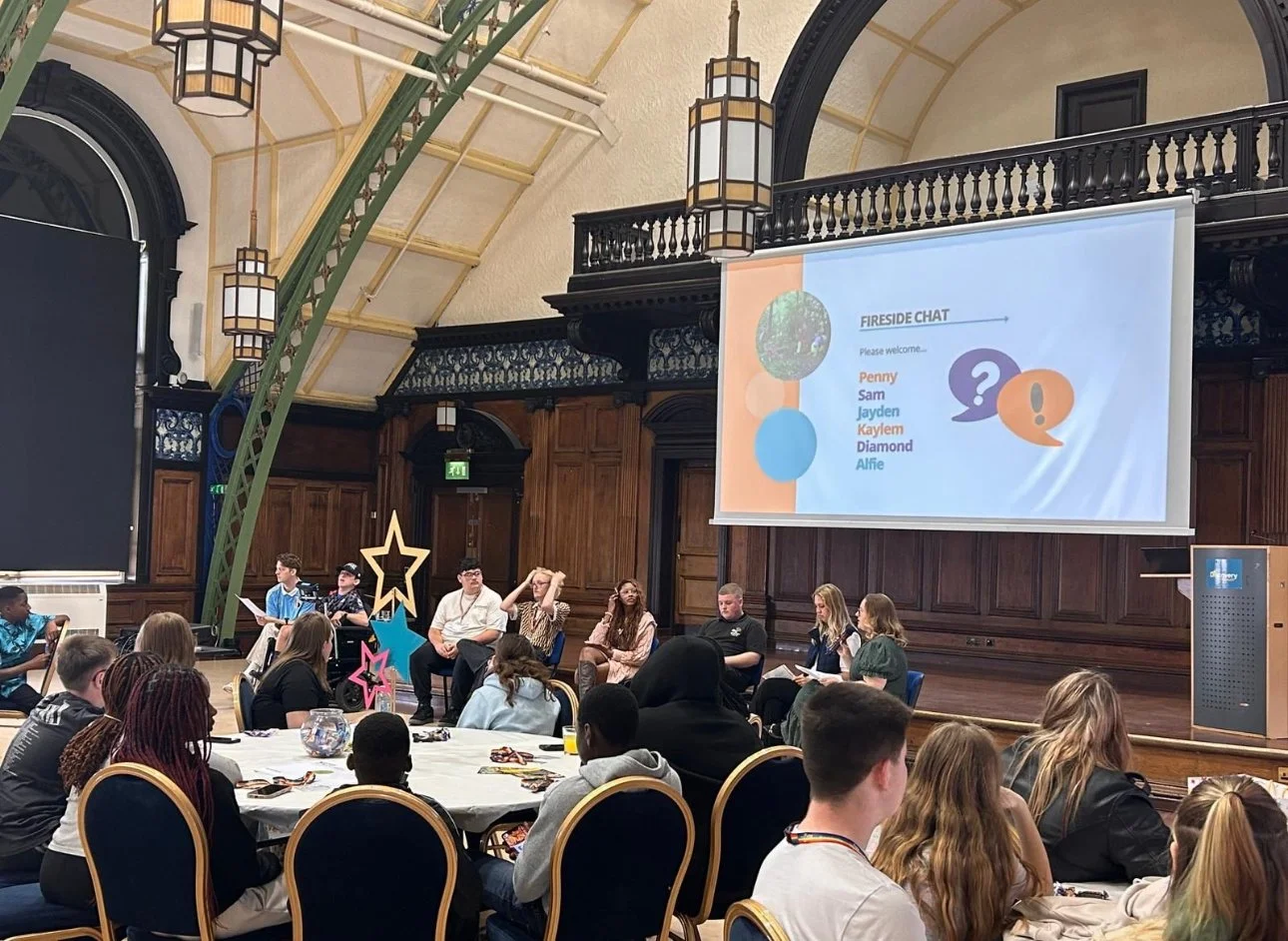
Rylie Sweeney hosting a fireside chat with young people.
I've seen the importance of that context particularly clearly in my own work. Following the riots across the UK in 2024, I worked on a project exploring young people's experiences of community cohesion, division and the environments they were growing up in.
Speaking directly with young people revealed layers that would have been incredibly difficult to understand from headline measures alone. Some of the conversations about trust in institutions were particularly striking. A young person's perspective wasn't always shaped solely by something that had happened directly to them. Their understanding could also be influenced by experiences within their family, conversations taking place around them and the wider community in which they were growing up.
Knowing how somebody felt told us something important. Understanding what sat behind that feeling told us much more.
That experience reinforced something I've seen repeatedly. A statistic can tell us what we can observe, but understanding why it exists requires us to look at the context around it. Sometimes that context is already captured elsewhere. Sometimes we have to go and find it.
That is where intelligence comes in.
Data and intelligence are not the same thing
Intelligence is not an alternative to data, and this isn't an argument about choosing quantitative or qualitative evidence. Both have value, and both have limitations.
For me, intelligence is what we build when evidence is brought together and interpreted in context. It means looking beyond an individual statistic and asking what sits behind it, what else we know and whether the picture changes when we hear from the people experiencing it.
Take attendance. Knowing that attendance has fallen is important. It can help us understand scale, identify patterns and see where change is happening. But if the decision in front of us is about how to improve attendance, knowing that it has fallen isn't enough. We need to understand what is driving that change and whether those reasons are the same for different young people and in different places.
That changes the question from simply “what does the data tell us?” to something broader: what is actually happening here, what do we understand about why it is happening, and what does that mean for the decision we need to make?
That is a much more useful starting point for policy and practice.
Young people's experiences are part of the evidence
I've spent a significant amount of my work in and around spaces where decisions about young people are discussed. I've seen the value of strong research and good data, but I've also seen how a conversation can change when young people explain what sits behind a statistic, challenge an assumption or describe something that wasn't visible in the information already available.
Their experiences should not sit separately from the evidence we consider when making decisions about their lives.
That doesn't mean an individual experience should be treated as representative of every young person, nor does it mean young people's experiences replace robust research or representative data. It means recognising what they can add to our understanding.
A conversation with a young person might reveal a question we haven't asked. It might help explain an unexpected pattern in the data or challenge the way we've interpreted something. It might identify a barrier that wasn't visible at all until somebody experiencing it described it.
The question should therefore be: what do we need to understand this issue well enough to make the decision in front of us?
Sometimes the evidence already exists. Sometimes new research is needed. Sometimes we need to work directly with young people to understand what isn't currently visible. Often, the strongest understanding comes from connecting more than one of those things.
Better intelligence matters for prevention
This becomes particularly important as government and public services increasingly focus on prevention and earlier intervention. Many of the outcomes we eventually see recorded in data are the end of a much longer story. By the time something becomes visible in a headline measure, there may have been months or years of experiences leading up to it.
If we want to act earlier, we need to understand more than the final outcome. We need to understand the journey towards it. That means being curious about what is changing in young people's lives before it becomes visible in the measures we routinely monitor. It means understanding how different parts of someone's life might be interacting and recognising that the same outcome can have very different stories behind it.
Place matters here too. Two areas can record similar headline outcomes while the circumstances producing them are very different. An employment challenge in one community might look similar in the data to an employment challenge somewhere else, but the opportunities available, local economy, transport connections and experiences of young people may produce a very different picture when we look beneath the headline.
If the context is different, the response may need to be different too. Better intelligence helps us understand that difference.
From collecting evidence to using it
There is already a huge amount of evidence about young people. More will continue to be produced, and rightly so. There are still important gaps in what we know and questions that require new research. But producing more evidence cannot be our only ambition. We also need to become better at connecting what we already know and being purposeful about the evidence we still need.
For me, that means beginning with the decision rather than the method. Before asking whether we need a survey, a new dataset, interviews or another piece of research, we should be clear about what we are actually trying to understand and what decision that understanding needs to inform.
From there, we can look at what is already known, identify where our understanding is incomplete and decide what additional evidence is genuinely needed.
That sounds like a relatively simple shift, but it changes the purpose of the work. Research isn't being commissioned simply to produce more information. Young people aren't being asked for their views simply because participation is expected. Data isn't being analysed simply because it is available.
Each is contributing to an understanding that has a clear purpose. And that makes it much more likely that evidence can move beyond describing an issue and actually help shape what happens next.
Building a connected understanding
For me, this is the opportunity.
We don't need to choose between data and young people's experiences, or between national evidence and what we understand about a particular place. The challenge is learning how to connect different forms of knowledge and understand what they collectively tell us.
Young people's lives are connected. Our understanding of them needs to become better connected too.
If we can do that, we move beyond knowing individual facts about young people's lives and towards understanding how those facts relate to one another, what they mean in context and what they should mean for the decisions being made.
That is the difference between having information and building intelligence.
As we think about the future of public services, prevention, local growth and opportunities for young people, the challenge is not simply to know more. It is to understand better.
Because better decisions for young people start with a better understanding of their lives.